
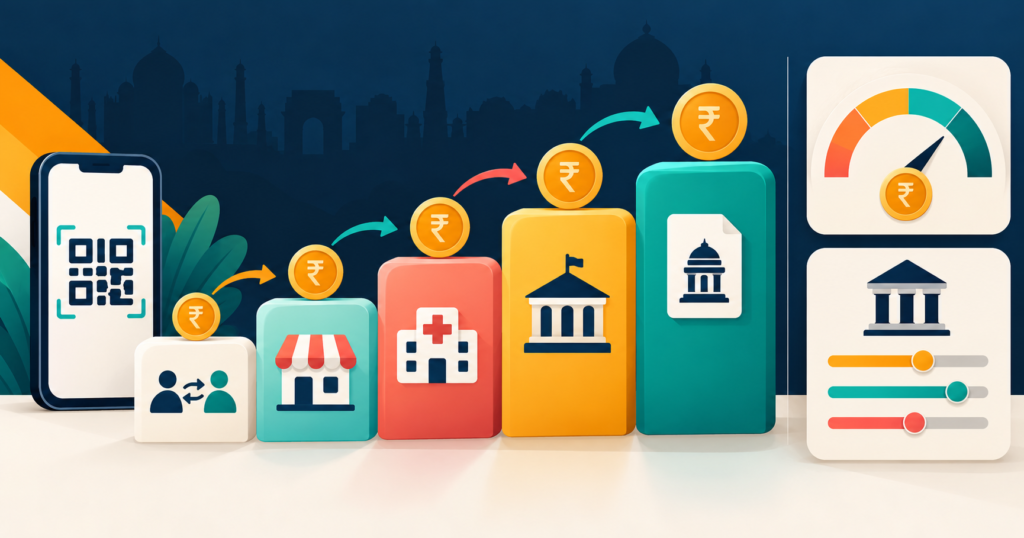
The normal UPI transaction limit in 2026 is up to ₹1 lakh per transaction, according to NPCI’s UPI – Frequently Asked Questions (National Payments Corporation of India, 2026). Yet that familiar number is only the starting point. Eligible payments in specified categories can have network ceilings of ₹2 lakh or ₹5 lakh.
This guide separates person-to-person transfers, ordinary merchant payments, special-category payments, UPI Lite, AutoPay and biometric authentication. The most important rule is simple: an NPCI ceiling is not a guaranteed allowance. Your bank, app, account risk controls and the receiver’s merchant classification can produce a lower limit. For wider troubleshooting, start with UPI help in India.
Key Takeaways
- Normal UPI transfers have a network ceiling of ₹1 lakh per transaction.
- Verified merchants in selected categories can receive up to ₹5 lakh.
- UPI Lite allows ₹1,000 per transaction and a ₹5,000 balance.
- Banks and apps may impose lower limits.
What is the normal UPI transaction limit in 2026?
In 2026, the normal UPI ceiling remains up to ₹1 lakh per transaction under NPCI’s UPI – Frequently Asked Questions (National Payments Corporation of India, 2026). This generally covers ordinary person-to-person transfers and merchant payments that do not qualify for a higher category-specific ceiling.
That figure is a network maximum, not a universal daily entitlement. A bank can apply lower payment, daily or transaction-count controls.
| Payment situation | Network-level position | Practical check |
|---|---|---|
| Normal P2P transfer | Up to ₹1 lakh per transaction | Check the sender bank’s daily and count limits |
| Ordinary P2M payment | Usually within the normal ceiling | Confirm the receiver is classified as a merchant |
| Eligible special category | Up to the category ceiling | Merchant must carry the correct category or purpose code |
| Bank or app rule | May be lower | The lowest applicable limit wins |
Citation capsule: In 2026, NPCI states that normal UPI has a transaction limit of up to ₹1 lakh per transaction. Banks may apply stricter internal controls, so the network ceiling does not guarantee that a particular account, app or payment will be allowed for the full amount.
[UNIQUE INSIGHT] A payment must pass the NPCI ceiling, category rules and bank controls. The smallest applicable gate determines what succeeds.
Are person-to-person and merchant limits the same?
In 2025, NPCI expressly kept person-to-person limits under existing rules while expanding limits for selected merchant categories in Addendum to OC 185 A: Implementation of Higher Per Transaction Limit for Specific Categories in UPI (National Payments Corporation of India, 2025). The expansion therefore did not turn every P2P transfer into a ₹5 lakh payment.
A P2P payment sends money to an individual. A P2M payment goes to a bank-classified merchant. Higher limits depend on verified-merchant status and the prescribed merchant or purpose code. Therefore, an eligible hospital payment may exceed ₹1 lakh while the same amount sent to a relative fails.
Citation capsule: In 2025, NPCI’s higher-limit circular required eligible recipients to be verified merchants and left P2P limits unchanged. A ₹5 lakh category ceiling applies only when the payment carries the required merchant classification, not merely because the receiver sells goods or services.
If a permitted payment fails and your account is debited, follow the UPI payment failed but money debited guide. Do not immediately repeat a high-value payment until you confirm its status.
Which special payments can have higher UPI limits?
In 2025, NPCI set ₹5 lakh per-transaction ceilings for several verified-merchant categories in Addendum to OC 185 A: Implementation of Higher Per Transaction Limit for Specific Categories in UPI (National Payments Corporation of India, 2025). The same circular also assigned separate 24-hour cumulative ceilings for many categories.
| Eligible category in NPCI OC 185B | Per transaction | Cumulative limit over 24 hours |
|---|---|---|
| Capital markets | ₹5 lakh | ₹10 lakh |
| Insurance | ₹5 lakh | ₹10 lakh |
| Government e-Marketplace EMD | ₹5 lakh | ₹10 lakh |
| Travel | ₹5 lakh | ₹10 lakh |
| Credit card bill payment | ₹5 lakh | ₹6 lakh |
| Collections | ₹5 lakh | ₹10 lakh |
| Jewellery | ₹2 lakh | ₹6 lakh |
| FX retail through BBPS | ₹5 lakh | ₹5 lakh |
| Opening a term deposit digitally | ₹5 lakh | ₹5 lakh |
| Initial funding for digital account opening | ₹2 lakh | ₹2 lakh |
In 2024, RBI raised tax payments from ₹1 lakh to ₹5 lakh in Statement on Developmental and Regulatory Policies (Reserve Bank of India, 2024). It also documented ₹5 lakh ceilings for hospitals and educational institutions in Annual Report 2023-24 (Reserve Bank of India, 2024). NPCI’s 2026 FAQ records ₹5 lakh for IPO subscriptions and RBI Retail Direct.
Citation capsule: By 2026, selected verified-merchant UPI payments could reach ₹5 lakh per transaction, including capital markets, insurance, travel and credit card bills. NPCI also prescribed category-specific 24-hour ceilings, such as ₹10 lakh for capital markets and ₹6 lakh for credit card bill payments.
[UNIQUE INSIGHT] Two valid ₹5 lakh insurance payments can exhaust the ₹10 lakh 24-hour ceiling. A third may fail despite meeting the single-payment cap.
What are the UPI Lite and UPI 123Pay limits?
In 2024, RBI set the UPI Lite ceiling at ₹1,000 per transaction and ₹5,000 as the total balance in its updated Framework for Facilitating Small Value Digital Payments in Offline Mode (Reserve Bank of India, 2024). Replenishing that balance must occur online with additional-factor authentication.
UPI Lite is a small-value arrangement. The ₹5,000 figure describes stored balance, while ₹1,000 limits one payment. Apps may support less.
In 2024, RBI proposed increasing the UPI 123Pay ceiling from ₹5,000 to ₹10,000 per transaction in Statement on Developmental and Regulatory Policies, October 9, 2024 (Reserve Bank of India, 2024). UPI 123Pay serves feature-phone users and has a separate product rule from UPI Lite.
Citation capsule: In 2024, RBI increased UPI Lite to ₹1,000 per transaction with a ₹5,000 stored-balance ceiling. It separately increased the UPI 123Pay per-transaction ceiling to ₹10,000, showing that product-specific limits should not be confused with normal bank-account UPI limits.
Does biometric approval change the UPI payment limit?
From 7 August 2026, the on-device biometric authentication ceiling became ₹10,000 per eligible transaction under NPCI’s Enhancement of Transaction Limit for On-Device Biometric Authentication in UPI (National Payments Corporation of India, 2026). The circular increased the earlier ₹5,000 biometric ceiling introduced in 2025.
This is an authentication-method limit, not the overall UPI limit. A higher payment may still be possible with another permitted route. Biometric approval remains optional and depends on device, app and bank support. NPCI’s 2025 Introduction of Additional Authentication Methods in UPI required explicit consent.
Citation capsule: In 2026, NPCI raised the on-device biometric authentication ceiling from ₹5,000 to ₹10,000 per eligible UPI transaction. This ceiling governs fingerprint or face approval, not the payment category’s underlying maximum, and implementation still depends on participating banks, apps and compatible devices.
Never approve an unfamiliar collect request merely because biometric confirmation feels quicker. Review the receiver and amount first, and use the 10-minute UPI fraud checklist if a payment appears unauthorised.
How do AutoPay limits differ from one-time payment limits?
In 2023, RBI raised the no-additional-factor ceiling for subsequent recurring debits from ₹15,000 to ₹1 lakh per transaction for mutual fund subscriptions, insurance premiums and credit card bills in Processing of e-Mandates for Recurring Transactions (Reserve Bank of India, 2023). This rule concerns recurring mandate execution, not ordinary transfers.
Other AutoPay arrangements can follow different conditions. A mandate amount, recurring-debit ceiling and one-time UPI limit are separate concepts.
Citation capsule: In 2023, RBI increased the recurring e-mandate ceiling without additional-factor authentication to ₹1 lakh per transaction for mutual funds, insurance premiums and credit card bills. The change applies to specified recurring debits and should not be read as a general ₹1 lakh AutoPay rule for every merchant category.
Why can a payment fail below the advertised limit?
In 2025, NPCI allowed member banks to set lower internal limits within its ceilings in Addendum to OC 185 A: Implementation of Higher Per Transaction Limit for Specific Categories in UPI (National Payments Corporation of India, 2025). A rejection below ₹1 lakh can therefore reflect a valid bank, app or account control.
Common reasons include a lower bank limit, too many transactions, a cumulative cap, a new device, insufficient funds, wrong merchant classification or an unsupported feature. Read the error, check the bank’s rules and confirm the receiver’s payment category. If debited, complain using the transaction reference rather than retrying.
Citation capsule: NPCI’s 2025 higher-limit circular gives banks discretion to impose internal limits below the network ceiling. Consequently, the amount shown in a national rule is the maximum possible for an eligible payment, while the user’s effective limit may be lower.
[UNIQUE INSIGHT] A qualifying purpose is insufficient if the payment lacks the approved merchant classification. It can fall back to the normal ceiling.
Frequently asked questions about UPI limits
In 2026, normal UPI remained capped at up to ₹1 lakh per transaction in NPCI’s UPI – Frequently Asked Questions (National Payments Corporation of India, 2026). The answers below clarify why daily, bank, merchant and product-specific numbers can still differ from that headline ceiling.
The practical rule for checking your limit
In 2025, NPCI permitted banks to use lower internal limits while allowing up to ₹5 lakh for selected verified-merchant payments in Addendum to OC 185 A (National Payments Corporation of India, 2025). So check four things before a large payment: payment type, merchant eligibility, bank rules and the 24-hour total.
For P2P, start with ₹1 lakh but expect bank controls. For special merchants, confirm category support. Apply separate rules to Lite, 123Pay, biometrics and AutoPay.
If a limit-related decline also debits your account, don’t pay again until the status is clear. Continue with the failed UPI payment recovery steps, or return to the UPI help India hub for the right complaint path.


