
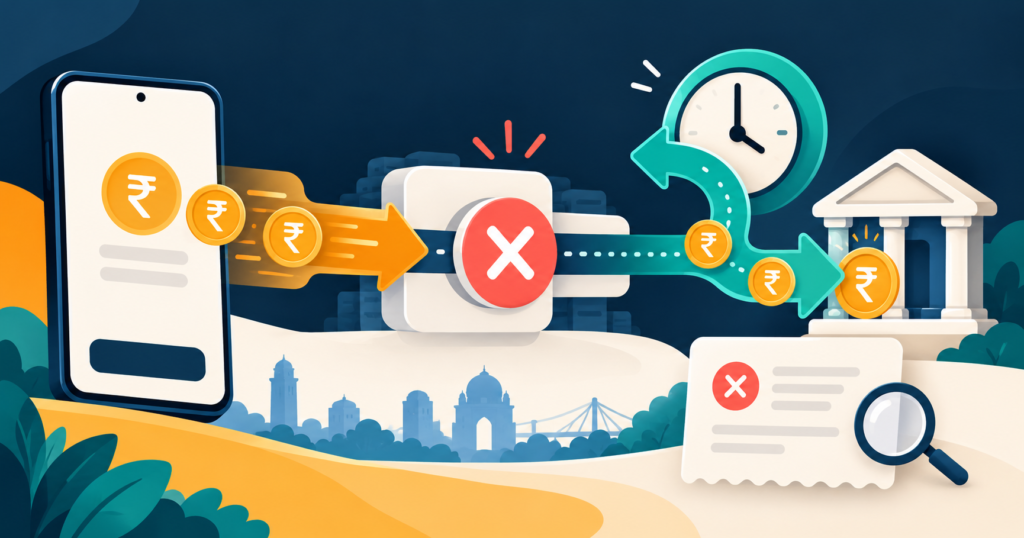
In 2019, the Reserve Bank of India set two different outer limits for debited UPI failures: T+1 day for an uncredited funds transfer and T+5 days for a merchant payment without confirmation. The rules appear in RBI’s Harmonisation of Turn Around Time (TAT) and customer compensation for failed transactions using authorised Payment Systems (RBI, 2019).
Identify whether the app shows failed, pending or successful. Then determine whether you sent money to a person or paid a merchant. Preserve the details, avoid paying twice and use the correct complaint route. For the wider decision tree, start with UPI help in India.
Key Takeaways
- In 2019, RBI’s Harmonisation of Turn Around Time set T+1 for failed transfers and T+5 for failed merchant payments.
- A pending payment is not automatically a failed payment.
- Save the transaction ID, amount, status and bank statement.
- RBI compensation is ₹100 per day after the applicable outer limit.
What Does “UPI Payment Failed but Money Debited” Actually Mean?
In 2019, RBI defined a failed transaction as one not fully completed for a reason not attributable to the customer, including a timeout or non-credit to the beneficiary. That definition comes from RBI’s Harmonisation of Turn Around Time (TAT) and customer compensation for failed transactions using authorised Payment Systems (RBI, 2019). Check the status before choosing a remedy.
“Failed” means the transfer did not complete, although your account may show a debit. NPCI says declined UPI transactions provide for real-time reversals. If the credit doesn’t return immediately, contact the bank, according to NPCI’s UPI Frequently Asked Questions (NPCI, 2026).
“Pending” means the final result remains unclear. In 2026, NPCI’s FAQ describes a pending case as successful at the UPI layer but delayed at the beneficiary bank, with possible credit within 48 hours. Don’t assume failure and pay again.
“Successful but not credited” requires both parties to check their linked bank statements, not only app notifications. If the beneficiary account remains uncredited, raise a complaint with the transaction reference. A successful wrong-recipient transfer and an unauthorised debit need separate recovery routes.
Unique analysis: The visible word in the app is only the first clue. The legally relevant question is what failed: a funds transfer to a beneficiary or a merchant confirmation. RBI assigns different outer limits to those two events, so a generic “UPI refund takes X days” answer can mislead.
Citation capsule: In 2019, RBI’s Harmonisation of Turn Around Time (TAT) and customer compensation for failed transactions using authorised Payment Systems defined failed transactions and set different UPI limits: T+1 for uncredited funds transfers and T+5 for merchant payments lacking confirmation.
What Should You Do Immediately After the Debit?
In 2023, NPCI’s UPI Help Guidelines said a debit-side complaint could be raised after 5 minutes for eligible failed or pending cases. The safest first move is therefore to preserve evidence, wait briefly for status synchronisation and avoid a duplicate payment while you verify the receiver’s account (NPCI, 2023).
- Open the transaction details. Record the UPI transaction ID, 12-digit RRN if shown, date, time, amount, payer UPI ID, payee UPI ID and current status.
- Check your bank statement. Confirm that the amount is a posted debit, not merely an app message.
- Ask the receiver to check the linked bank account. A notification delay doesn’t prove non-credit.
- Take screenshots. Capture the transaction page and bank statement entry. Hide unrelated balances before sharing them.
- Do not share your UPI PIN. A genuine refund never requires you to approve a collect request or reveal the PIN.
- Avoid paying again. Retry only after the first payment has clearly failed and the recipient confirms no credit.
If the payment was successful but went to the wrong person, the failed-payment timeline does not apply. Follow the separate guide for when you sent money to the wrong UPI ID. If you did not authorise the debit, use the urgent steps in the UPI fraud emergency checklist.
Citation capsule: In 2023, NPCI’s UPI Help Guidelines indicated that eligible debit-side complaints could be raised after 5 minutes. Users should save the transaction reference, verify both bank accounts and avoid retrying during that initial status-check window. These steps reduce duplicate-payment risk while preserving evidence for a complaint.
When Should a UPI Refund or Reversal Arrive?
In 2019, RBI’s Harmonisation of Turn Around Time (TAT) and customer compensation for failed transactions using authorised Payment Systems set T+1 for uncredited UPI funds transfers and T+5 for merchant payments without confirmation. Here, T means the calendar date of the transaction, not the hour when the payment was attempted (RBI, 2019).
For a person-to-person or funds transfer, the beneficiary bank must either credit the beneficiary or complete auto-reversal by T+1. For a merchant payment where your account was debited but the merchant received no confirmation, auto-reversal has an outer limit of T+5. Banks and payment participants should still try to resolve failures sooner.
| UPI problem covered by RBI | Outer limit | Compensation after the limit |
|---|---|---|
| Account debited, beneficiary not credited | T+1 day | ₹100 per day of delay |
| Account debited, merchant gets no confirmation | T+5 days | ₹100 per day of delay |
In 2019, the same RBI circular required ₹100 per day when delay extends beyond the applicable T+1 or T+5 limit. It also says compensation should be credited automatically, without waiting for the customer to make a claim. Check the reversal and any compensation as separate entries in your statement.
In 2026, NPCI’s UPI Frequently Asked Questions tells users to contact bank support if a failed-payment refund doesn’t arrive within 1 hour. That is an operational trigger, not a replacement for RBI’s T+1 or T+5 outer limits.
Citation capsule: In 2019, RBI’s Harmonisation of Turn Around Time (TAT) and customer compensation for failed transactions using authorised Payment Systems required UPI reversal by T+1 or T+5, depending on payment type. Delay beyond the applicable limit attracts automatic compensation of ₹100 per day.
How Do You Complain About a UPI Reversal Delay?
In 2026, NPCI’s UPI Frequently Asked Questions directs users to raise a grievance or check transaction status through a participating bank’s UPI app. Start inside the app, then complain to your account-holding bank with the same evidence. Escalate to RBI only after the bank has had its required opportunity to respond (NPCI, 2026).
Step 1: Raise the issue inside the UPI app
Open transaction history, select the payment and choose the option resembling “report issue,” “raise complaint” or “help.” Pick the reason that matches the record: failed payment not reversed, pending transfer, beneficiary not credited or merchant not confirmed. Save the complaint number and a screenshot of the submission.
Step 2: Complain to your bank
Use the bank’s official app, website, helpline or branch. Include the transaction ID, RRN, amount, date, status, payee details, statement debit and app complaint number. Ask for both the payment outcome and the reversal date. If the RBI outer limit has passed, ask the bank to verify the automatic ₹100-per-day compensation.
Step 3: Escalate under RBI’s ombudsman scheme
In 2026, RBI’s Reserve Bank – Integrated Ombudsman Scheme, 2026: Frequently Asked Questions says the scheme is cost-free. You may complain through the CMS portal if the regulated entity rejects the complaint, gives an unsatisfactory response or doesn’t reply within 30 days (RBI, 2026).
Submit the bank complaint reference, transaction evidence, bank response and the relief you seek at RBI’s Complaint Management System. Don’t go straight to the Ombudsman without first complaining to the bank. A premature complaint may not be maintainable under the scheme.
Unique analysis: Keep one evidence packet containing the transaction screen, statement debit, receiver confirmation and every complaint number. Reusing the same packet makes escalation clearer and prevents dates, amounts or status descriptions from changing between submissions.
Citation capsule: In 2026, RBI’s Reserve Bank – Integrated Ombudsman Scheme, 2026: Frequently Asked Questions describes cost-free escalation after the customer approaches the regulated entity. A complaint may proceed after rejection, an unsatisfactory resolution or no reply within 30 days. Online complaints go through RBI’s CMS portal.
Frequently Asked Questions
In 2019, RBI set a ₹100-per-day compensation rule for UPI delays beyond the applicable T+1 or T+5 outer limit in Harmonisation of Turn Around Time (TAT) and customer compensation for failed transactions using authorised Payment Systems. These answers apply that rule to common questions without collapsing different transaction statuses into one timeline (RBI, 2019).
What Should You Remember Before Closing the Complaint?
In 2019, RBI assigned T+1 to an uncredited UPI funds transfer and T+5 to a merchant payment without confirmation, with ₹100 daily compensation after the applicable limit. The practical answer is simple: classify the transaction correctly, preserve evidence, complain early and verify both reversal and compensation (RBI, 2019).
Check the bank statement rather than relying only on app notifications. Keep the complaint open until the money reaches the correct account and any due compensation appears. If the failure may be a transaction-limit decline, check the UPI transaction limits in 2026. For other status patterns, return to the UPI help in India hub.
Citation capsule: In 2019, RBI’s Harmonisation of Turn Around Time (TAT) and customer compensation for failed transactions using authorised Payment Systems set T+1 for an uncredited UPI transfer and T+5 for an unconfirmed merchant payment. Correct classification determines the deadline and compensation rule.


