
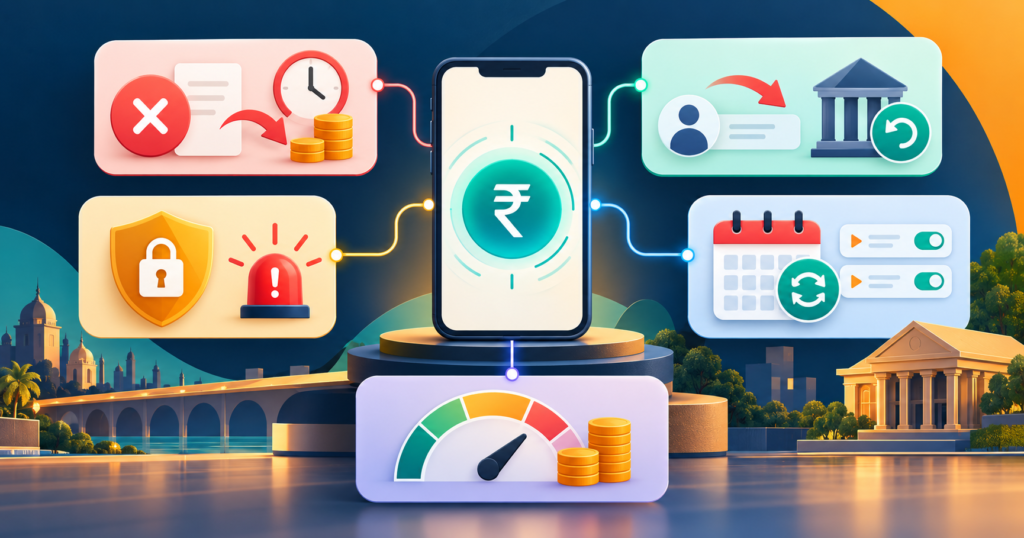
In August 2026, UPI processed 24,508.96 million transactions worth ₹29,82,355.95 crore, according to NPCI’s Unified Payments Interface Product Statistics (NPCI, 2026). At that scale, a failed, pending, mistaken or suspicious payment can feel alarming. The right response depends on the transaction status, the payment type and whether fraud is involved.
This UPI help India guide gives you one decision path for the most common problems. You will learn when to wait, where to complain, how RBI reversal rules work, what to do after a wrong transfer, and how to control AutoPay mandates. It complements the existing UPI Help Centre and the plain-language guide to how UPI works.
Key Takeaways
- In August 2026, NPCI recorded 24.5 billion transactions in Unified Payments Interface Product Statistics (NPCI, 2026).
- Check the status before paying again.
- Failed transfers and failed merchant payments follow different RBI timelines.
- Report suspected fraud immediately to your bank and 1930.
On this page
- What UPI help covers
- How to diagnose a transaction
- Failed and debited payments
- Wrong UPI transfers
- UPI fraud response
- AutoPay mandate controls
- UPI limits
- Complaint escalation
- Five-minute action plan
- Frequently asked questions
What Does UPI Help in India Cover?
In August 2026, 752 banks were live on UPI, according to NPCI’s Unified Payments Interface Product Statistics (NPCI, 2026). UPI help therefore spans more than one app: it connects the payer’s app, payer’s bank, NPCI switch, receiver’s bank and, for purchases, the merchant’s payment setup.
UPI is an instant bank-to-bank payment system built over IMPS infrastructure. NPCI developed it, while regulated banks and apps provide customer access. An app may display the status, but your bank usually owns the complaint and account correction.
A practical help system covers five problem families:
| Problem | First check | First contact |
|---|---|---|
| Failed or pending payment | Transaction history and bank statement | UPI app, then your bank |
| Wrong recipient | Beneficiary name, UPI ID and reference number | Your bank immediately |
| Suspected fraud | Account debit and device access | Bank fraud desk and 1930 |
| AutoPay issue | Active mandates and next debit date | App mandate controls, then bank |
| Limit or decline | Amount, category and bank limit | App or issuing bank |
Do not treat every debit as fraud. A failed transfer, merchant confirmation failure, successful wrong transfer and unauthorised debit each follow different remedies. In 2026, NPCI’s UPI Frequently Asked Questions describes a UPI PIN as 4 to 6 digits and says it must not be shared (NPCI, 2026).
Citation capsule: In August 2026, UPI connected 752 live banks and processed 24,508.96 million transactions, according to NPCI’s Unified Payments Interface Product Statistics (NPCI, 2026). Users should begin troubleshooting with the transaction record, then involve the app and account-holding bank when the status or debit remains unresolved.
How Should You Diagnose a UPI Problem?
In the 2023 UPI Help Guidelines, NPCI says a debit-side complaint may be raised after 5 minutes, while successful person-to-person payments are excluded from that particular complaint route (NPCI, 2023). Start by identifying the exact status and payment type, not by sending the same payment again.
Open the transaction inside the app and record these details before taking action:
- Transaction status: successful, failed, pending or unknown.
- Payment type: person-to-person transfer or merchant payment.
- Transaction date, time and amount.
- UPI transaction ID, bank reference number or RRN.
- Payer and payee UPI IDs, plus the displayed beneficiary name.
- Bank statement entry and complaint reference number, if one exists.
Compare the app status with the bank statement. If no debit appears, no refund is due. For a pending status, use the refresh feature. If money was debited, avoid retrying until you confirm whether the receiver got the first payment.
Quick decision rule
- No debit: correct the likely input, network or PIN issue before retrying.
- Debit plus failed or pending status: preserve the record and follow the reversal timeline.
- Successful but wrong recipient: contact the bank immediately, because the payment cannot simply be stopped.
- You did not authorise it: use the fraud route now, not the ordinary failed-payment queue.
Unique analysis based on official rules: The word “failed” is not enough to choose a remedy. RBI gives person-to-person non-credit and merchant confirmation failures different outer reversal limits. Identifying the payment type can change the relevant timeline from T+1 to T+5 days.
Citation capsule: NPCI’s 2023 UPI Help Guidelines permits a debit-transaction complaint after 5 minutes and offers transaction-status refresh inside UPI Help (NPCI, 2023). Users should capture the status, payment type, amount, UPI ID and reference number before retrying or escalating. A decline may also require checking the UPI transaction limits in 2026.
What If a UPI Payment Failed but Money Was Debited?
Under RBI’s 2019 Harmonisation of Turn Around Time and Customer Compensation for Failed Transactions, a debited person-to-person UPI transfer must be credited or reversed by T+1 day. A failed merchant payment has a T+5-day auto-reversal limit, with ₹100 per day compensation after the applicable deadline (RBI, 2019).
Confirm whether the beneficiary or merchant received the money. Ask them to check their bank statement, not only an app notification. A second payment could create a duplicate.
“T” means the calendar date of the transaction. The RBI limits are outer limits, and banks should try to resolve failures faster. The compensation is supposed to reach the customer’s account automatically, without waiting for a separate claim.
| Failed UPI scenario | RBI outer limit | Compensation after limit |
|---|---|---|
| Account debited, beneficiary not credited | T+1 day | ₹100 per day |
| Account debited, merchant confirmation not received | T+5 days | ₹100 per day |
Raise an in-app complaint and save its reference number. If the transaction is missing or the reply is unclear, complain directly to your account-holding bank. Include the transaction ID, amount, date, status and statement entry.
Do not share your UPI PIN, one-time password or screen-control access with anyone offering a “refund.” A genuine reversal does not require you to approve a collect request or enter a PIN to receive money.
Citation capsule: RBI’s 2019 failed-transaction framework requires a debited person-to-person UPI transfer to be credited or reversed by T+1 day. Failed merchant payments carry a T+5-day outer limit. After the relevant deadline, the framework sets automatic compensation at ₹100 per day (RBI, 2019). Follow the full process for what to do when a UPI payment fails but money is debited.
What If You Sent Money to the Wrong UPI ID?
In 2026, NPCI’s Register a Complaint portal requires a 12-digit transaction number or RRN for its transaction complaint flow (NPCI, 2026). If you paid the wrong person, capture that reference immediately and contact your bank, because NPCI says an initiated UPI payment cannot be stopped.
A successful wrong transfer differs from a failure. There is no universal cancel button after completion. Recovery may require bank coordination, recipient consent, a formal dispute and, for suspected deception, a cybercrime complaint.
Use this sequence:
- Save the payment record, RRN, recipient UPI ID, beneficiary name and amount.
- Call your bank using the number on its official website or app.
- Raise a written complaint and ask for the complaint reference.
- Contact the recipient only through safe, documented channels. Never threaten or publish their details.
- If deception or impersonation caused the payment, call 1930 and report at cybercrime.gov.in.
- Escalate an unresolved service complaint under the applicable RBI Ombudsman rules.
Describe the event precisely. “Wrong UPI ID entered by me” and “fraudster induced me to pay” can trigger different investigations. Neither path guarantees recovery.
Citation capsule: NPCI’s UPI Frequently Asked Questions states that an initiated UPI payment cannot be stopped (NPCI, 2026). A mistaken successful transfer should therefore be reported immediately with its 12-digit RRN, recipient details and amount. Use the detailed steps after sending money to the wrong UPI ID, while suspected deception should also follow the national cyber-fraud reporting route.
What Should You Do After Suspected UPI Fraud?
By January 31, 2026, I4C’s reporting system had helped save more than ₹8,690 crore across over 24.65 lakh complaints, according to the Ministry of Home Affairs’ Lok Sabha Unstarred Question No. 4118 (MHA, 2026). Report suspected UPI fraud immediately to your bank and the 1930 helpline.
Speed matters because banks, payment intermediaries and law enforcement may try to trace and stop funds before further transfers. Follow this order without waiting for a social-media support reply:
- Call your bank’s official fraud number and report the unauthorised or induced transaction.
- Ask the bank to block further digital transactions if account access may be compromised.
- Call 1930 and note the acknowledgement number.
- Complete the complaint at cybercrime.gov.in with transaction evidence.
- Change the app passcode, banking password and UPI PIN from a trusted device when the bank advises it.
- Preserve messages, phone numbers, QR codes, screen recordings and payment references.
In RBI’s 2017 Customer Protection: Limiting Liability of Customers in Unauthorised Electronic Banking Transactions, a third-party breach reported within 3 working days can qualify for zero customer liability when neither the bank nor customer is at fault (RBI, 2017). The bank must provide a shadow reversal within 10 working days after notification, subject to the circular’s conditions.
This is not a blanket refund promise. RBI says customers who share payment credentials may bear losses until they notify the bank. Fast reporting still limits further loss and creates a time-stamped trail.
Unique analysis based on official data: In 2026, our calculation from the Ministry of Home Affairs’ Lok Sabha Unstarred Question No. 4118 aggregate indicates roughly ₹35,000 saved per complaint (MHA, 2026). This is not an individual recovery forecast, but it shows why immediate reporting matters.
Citation capsule: By January 31, 2026, I4C’s Citizen Financial Cyber Fraud Reporting and Management System had helped save more than ₹8,690 crore in over 24.65 lakh complaints. The Ministry of Home Affairs directs financial-fraud victims to the toll-free 1930 helpline and National Cybercrime Reporting Portal (MHA, 2026). The 10-minute UPI fraud emergency checklist puts those contacts in order.
How Do You Control a UPI AutoPay Mandate?
Since UPI AutoPay launched in July 2020, NPCI has supported 4 core mandate actions: approve, modify, pause and revoke, according to its NPCI Introduces AutoPay Facility on UPI for Recurring Payments release (NPCI, 2020). Use your app’s mandate section before contacting support.
An AutoPay mandate authorises recurring debits under an agreed amount, frequency and validity. Pausing temporarily stops execution, while revoking ends the mandate. Available controls depend on the app, bank and merchant.
Before approving any mandate, verify:
- Merchant or biller name and UPI handle.
- Maximum amount per cycle.
- Frequency, start date and end date.
- Debit account.
- Whether the instruction is one-time or recurring.
NPCI’s 2024 UPI AutoPay Brand Guidelines says users may pause or revoke a mandate at any time and use a UPI PIN to authorise creation (NPCI, 2024). Review the next debit date after pausing or cancelling, then keep the confirmation message.
If a debit occurs after revocation, complain through the app and bank with the mandate ID, confirmation and debit reference. Check all mandate records before creating another instruction.
Citation capsule: NPCI’s UPI AutoPay framework supports 4 customer controls: approval, modification, pause and revocation. Its 2024 brand guidelines also state that a user may pause or revoke a recurring mandate at any time (NPCI, 2024). Availability and labels can differ by app, so follow the guide to cancel, pause or move a UPI AutoPay mandate.
What Are the UPI Transaction Limits in 2026?
In 2026, NPCI’s UPI Frequently Asked Questions lists a normal UPI ceiling of ₹1 lakh per transaction, selected categories at ₹2 lakh, and IPO plus Retail Direct payments at ₹5 lakh (NPCI, 2026). Your actual usable limit can be lower because banks and apps apply their own controls.
Limits depend on the category, account, bank policy, app risk checks and recent device changes. A decline above your bank’s limit does not automatically indicate an outage.
| UPI payment category | NPCI-listed per-transaction ceiling |
|---|---|
| Normal UPI | Up to ₹1 lakh |
| Capital markets, collections, insurance and foreign inward remittances | Up to ₹2 lakh |
| IPO and Retail Direct Scheme | Up to ₹5 lakh |
| Tax payments | Up to ₹5 lakh under RBI’s 2024 policy decision |
In 2024, RBI’s Statement on Developmental and Regulatory Policies raised the UPI limit for tax payments from ₹1 lakh to ₹5 lakh per transaction (RBI, 2024). Category eligibility still matters, so do not assume every transfer can use the highest figure.
After a limit-related decline, check the bank’s official limit and avoid rapid retries. Repeated debits complicate reconciliation. For context, compare UPI with cards, wallets, net banking and cash.
Citation capsule: In 2026, NPCI listed normal UPI payments at up to ₹1 lakh per transaction, selected categories at up to ₹2 lakh, and IPO or Retail Direct payments at up to ₹5 lakh. RBI separately raised the tax-payment limit to ₹5 lakh in 2024 (NPCI, 2026). Compare the person-to-person, merchant and special UPI limits before attempting a large payment.
How Do You Escalate a UPI Complaint?
From July 1, 2026, the RBI Integrated Ombudsman Scheme 2026 provides cost-free redress for eligible service-deficiency complaints, according to RBI’s Reserve Bank Integrated Ombudsman Scheme, 2026 FAQs (RBI, 2026). You must normally complain to the regulated entity first, then escalate under the Scheme’s maintainability rules.
Use a documented escalation ladder:
- UPI app: Raise an issue against the transaction and save the ticket.
- Account-holding bank: Use its official grievance channel, even if another app initiated the payment.
- Bank nodal escalation: Follow the bank’s grievance policy if the first reply is unsatisfactory.
- RBI CMS: File at cms.rbi.org.in when eligible under RB-IOS 2026.
- Cybercrime route: Keep 1930 and cybercrime.gov.in separate for suspected fraud or criminal conduct.
NPCI’s UPI Complaints Handling Process directed member banks to acknowledge customer complaints regardless of which UPI app the customer used (NPCI, 2017). If a bank simply redirects you to the app, ask it to register and acknowledge the complaint against your account.
State the remedy requested: status correction, reversal, RBI compensation, mandate correction or investigation. Attach the record and prior replies, but redact your PIN, OTP and complete card credentials.
Unique analysis based on official processes: The most useful complaint is a short evidence packet, not a long narrative. One page containing the transaction type, RRN, status, timeline, requested remedy and prior ticket numbers maps directly to the decision points used by the app, bank and Ombudsman.
Citation capsule: RBI’s Integrated Ombudsman Scheme 2026 took effect on July 1, 2026 and replaced the 2021 Scheme for new complaints. It offers a cost-free route for eligible service-deficiency disputes after the customer has first approached the regulated entity and satisfied the Scheme’s timing and maintainability requirements (RBI, 2026).
How Can You Start Fixing a UPI Problem Now?
NPCI’s 2023 UPI Help Guidelines allows a supported debit-side complaint after 5 minutes (NPCI, 2023). Your first action is simple: open the affected transaction, refresh its status once and save the full record before retrying, contacting support or changing account controls.
Use this five-minute checklist:
- Minute 1: Confirm the debit in your bank statement.
- Minute 2: Record the status, amount, date, UPI IDs and reference number.
- Minute 3: Ask the recipient or merchant to check their statement if safe.
- Minute 4: Raise the correct in-app issue or call the bank for fraud.
- Minute 5: Save the ticket and note the applicable next deadline.
Then choose one path. Track a genuine failure within its RBI reversal window. Escalate a wrong transfer immediately. Report fraud to the bank and 1930 now. For AutoPay, preserve the pause or revocation confirmation.
Citation capsule: NPCI’s 2023 UPI Help process lets users raise supported debit-transaction complaints after 5 minutes and refresh pending statuses inside the help flow (NPCI, 2023). A complete transaction record prevents duplicate payment and gives the bank the identifiers needed for investigation.
Frequently Asked Questions
In August 2026, UPI processed 24,508.96 million payments across 752 live banks, according to NPCI’s Unified Payments Interface Product Statistics (NPCI, 2026). The answers below cover the most common UPI help questions, but your transaction record and bank’s official response determine the next step in an individual case.
Citation capsule: In 2019, RBI established separate outer reversal limits for UPI failures: T+1 day for a debited transfer without beneficiary credit and T+5 days for a merchant confirmation failure. Compensation is ₹100 per day after the relevant limit, and it should be credited automatically (RBI, 2019).
The Safest UPI Help Rule Is to Match the Remedy to the Status
In August 2026, UPI carried ₹29,82,355.95 crore in one month, according to NPCI’s Unified Payments Interface Product Statistics (NPCI, 2026). At that scale, good UPI help depends on disciplined triage: verify the status, identify the payment type, preserve the reference and use the correct escalation path.
A failed transfer follows T+1 rules, while a failed merchant confirmation follows T+5 rules. Wrong payments cannot simply be cancelled. Fraud requires immediate bank and 1930 reporting. AutoPay needs mandate controls.
Keep one rule in mind: never enter a UPI PIN to receive money. For your next step, use the detailed guides below or return to the UPI Help Centre.
Continue with the UPI Help India cluster
Payment problems and fraud
Mandates and limits
This guide provides general educational information. It does not replace your bank’s investigation, RBI directions or legal advice for a specific dispute.


