
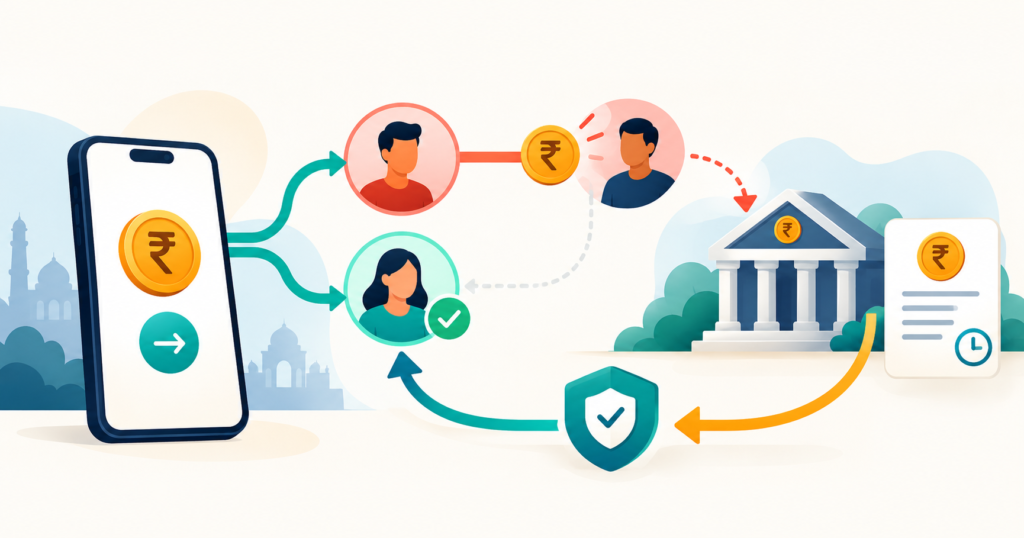
In August 2026, UPI processed 24,508.96 million transactions, according to NPCI’s Unified Payments Interface Product Statistics (NPCI, 2026). If one of those payments went to the wrong UPI ID, act immediately. Save the transaction record, contact your bank, and ask it to begin the wrong-credit recovery process.
A completed, authorized mistaken transfer is not automatically reversible. NPCI says an initiated UPI payment cannot be stopped. The recipient’s bank may need to contact its customer, and recovery is not guaranteed. This guide explains the practical sequence. For the wider complaint system, start with UPI help in India.
Key Takeaways
- In 2026, NPCI’s Register a Complaint requires the 12-digit RRN. Save it immediately (NPCI, 2026).
- Report the mistake to your bank, not only the app.
- Recovery may require recipient cooperation and is not guaranteed.
- Treat deception or an unauthorized debit as fraud.
Can You Cancel a Payment Sent to the Wrong UPI ID?
In 2026, NPCI’s UPI Frequently Asked Questions gives one direct rule: once a UPI payment is initiated, it cannot be stopped (NPCI, 2026). You therefore cannot rely on a cancel button after a completed authorized transfer. You must request recovery through your bank.
Confirm that the status says successful. A failed or pending payment follows another path. Tell the bank you authorized the payment but selected the wrong beneficiary.
Important: A wrong-credit complaint starts recovery. It does not let a bank automatically debit another customer’s account.
Citation capsule: In 2026, NPCI’s UPI Frequently Asked Questions states that an initiated UPI payment cannot be stopped. A completed authorized payment to a wrong UPI ID therefore needs a bank-led recovery request, not a cancellation request, and the recovery outcome is not guaranteed (NPCI, 2026).
Step 1: Save the 12-Digit RRN and Payment Evidence
In 2026, NPCI’s Register a Complaint form requires a 12-digit transaction number or Retrieval Reference Number, called an RRN (NPCI, 2026). Your first step is to capture that reference, the amount, date, time, recipient UPI ID, displayed name, and transaction status.
Save the app record, bank statement entry, SMS alert, and complaint acknowledgements.
Record these details in one note:
- UPI transaction ID and 12-digit RRN.
- Amount, date, and exact time.
- Recipient UPI ID and displayed name.
- Transaction status and a factual description of the mistake.
Unique analysis from official complaint fields: The RRN connects the app record to bank systems. A screenshot alone gives support teams less precise tracing information.
Citation capsule: NPCI’s 2026 Register a Complaint flow requires a 12-digit RRN and transaction details. Someone who sent money to the wrong UPI ID should preserve that RRN, payment status, amount, date, beneficiary name, UPI ID, statement debit, and every complaint reference before contacting support (NPCI, 2026).
Step 2: Report the Wrong UPI Transfer to Your Bank
NPCI’s 2023 UPI Help Guidelines says its standard in-app flow accepts debit complaints after 5 minutes, but excludes successful person-to-person payments (NPCI, 2023). For a successful wrong UPI transfer, contact your account-holding bank directly and request wrong-credit recovery.
Use the bank’s official number, secure app, complaint form, or branch. Avoid numbers from advertisements or comments.
Use plain wording such as:
“I authorized a successful UPI transfer to the wrong UPI ID. Please register a wrong-credit recovery request. My 12-digit RRN is [number].”
Get the complaint number, registered date, and escalation contact. “Chargeback” describes a process, not a refund promise.
If the app shows failed or pending instead, use the UPI payment failed but money was debited process. A successful transfer to the wrong recipient does not follow ordinary auto-reversal rules.
Citation capsule: NPCI’s 2023 UPI Help Guidelines allows a debit complaint after 5 minutes but excludes successful person-to-person transactions from that standard route. A successful wrong UPI transfer should be reported directly to the sender’s bank as a wrong-credit recovery request, supported by the RRN and payment evidence (NPCI, 2023).
Step 3: Let the Banks Run the Wrong-Credit Process
In 2026, NPCI listed Revision of Turnaround Time for Responding to Fraud and Wrong Credit Chargebacks in URCS Back Office System as UPI Circular OC 235 (NPCI, 2026). This confirms that wrong-credit cases have a formal bank-side dispute category. It does not make every mistaken transfer reversible.
Your bank can route the complaint to the beneficiary bank. That bank may check the receiving account and contact its customer. Keep all communication official.
You may contact a known recipient safely. Never share a PIN, OTP, card details, or screen access. Receiving money needs no UPI PIN.
If the recipient refuses, continue through the bank’s written grievance system and request the closure reason.
Unique analysis from official routes: Speed improves traceability, not automatic reversibility. Report quickly to create a bank-to-bank recovery record before funds move again.
Citation capsule: NPCI’s 2026 UPI circular list includes OC 235 for fraud and wrong-credit chargebacks in the URCS back-office system. The listing establishes a formal bank-side category for these disputes, but it does not promise automatic recovery after an authorized mistaken transfer (NPCI, 2026).
Was It a Mistake or UPI Fraud?
By January 31, 2026, I4C’s system had helped save more than ₹8,690 crore across over 24.65 lakh complaints, according to the Ministry of Home Affairs’ Rajya Sabha Unstarred Question No. 2161 (MHA, 2026). Report deception or an unauthorized debit immediately through 1930 and cybercrime.gov.in.
A mistake means you intended to pay but chose the wrong recipient. Fraud may involve impersonation, deception, account compromise, or an unauthorized payment.
If deception is involved, call the bank’s fraud desk and 1930. Report at cybercrime.gov.in and preserve evidence. Use the 10-minute UPI fraud emergency checklist for the full sequence.
RBI’s 2017 Customer Protection: Limiting Liability of Customers in Unauthorised Electronic Banking Transactions gives conditional zero liability for certain third-party breaches reported within 3 working days (RBI, 2017). It does not cover every authorized mistake.
Citation capsule: By January 31, 2026, I4C had helped save more than ₹8,690 crore across over 24.65 lakh financial-fraud complaints. The Ministry of Home Affairs’ Rajya Sabha Unstarred Question No. 2161 directs victims to 1930 and the National Cybercrime Reporting Portal for immediate reporting (MHA, 2026).
How Do You Escalate an Unresolved Wrong UPI Payment Complaint?
Since July 1, 2026, RBI’s Reserve Bank – Integrated Ombudsman Scheme, 2026 allows escalation when a regulated entity has not replied within 30 days, or when its response does not satisfy the complainant (RBI, 2026). Complain to the bank first, then use RBI CMS if eligible.
Follow the bank’s grievance ladder before approaching RBI. Attach the complaint, RRN, evidence, responses, and the resolution you seek.
File through RBI’s Complaint Management System when eligible. The Ombudsman examines service deficiency. It does not guarantee recovery from a mistaken beneficiary.
Preserve a clear timeline: payment time, first report, complaint number, each response, and escalation date.
Citation capsule: RBI’s Reserve Bank – Integrated Ombudsman Scheme, 2026 took effect on July 1, 2026. A customer may approach the RBI Ombudsman after first complaining to the regulated entity if no reply arrives within 30 days, or if the response is unsatisfactory, subject to the Scheme’s maintainability requirements (RBI, 2026).
Common Mistakes That Reduce Your Chances of Recovery
In 2026, NPCI’s UPI Frequently Asked Questions describes the UPI PIN as a 4 to 6 digit code used to authorize bank transactions (NPCI, 2026). Never disclose it while seeking help. A genuine bank or recipient does not need your PIN to return money.
- Waiting for auto-reversal: A completed authorized transfer is not a failed payment. Contact your bank.
- Calling an unverified support number: Use only the bank’s app, statement, card, or official website.
- Approving a “refund” request: Never pay a fee, approve a collect request, or scan another QR code to receive money.
- Misstating the event: Tell the bank whether you made an input mistake, were deceived, or never authorized the debit.
For recurring debits that went to the wrong merchant, review the steps to cancel or pause a UPI AutoPay mandate before the next scheduled payment.
Citation capsule: NPCI’s 2026 UPI Frequently Asked Questions says the UPI PIN is a 4 to 6 digit authorization code and should not be shared. Anyone offering recovery who asks for that PIN, an OTP, remote-screen access, or a new payment should be treated as suspicious (NPCI, 2026).
Frequently Asked Questions
In 2026, NPCI’s complaint portal asks for a 12-digit RRN, while RBI’s Ombudsman framework uses a 30-day bank-response threshold for many escalations (NPCI, 2026; RBI, 2026). The practical path is to identify the payment, complain to the bank, then escalate when eligible.
Act Now, but Set Realistic Expectations
In August 2026, 752 banks were live on UPI, according to NPCI’s Unified Payments Interface Product Statistics (NPCI, 2026). That network makes bank-to-bank recovery possible, but not automatic. Your best response is fast, factual, documented, and routed to the correct team.
Save the 12-digit RRN, contact your bank, request wrong-credit recovery, and keep every reference. If fraud caused the payment, report it to the bank, 1930, and cybercrime.gov.in immediately. If the bank’s service response remains unresolved, use its escalation ladder and RBI CMS when eligible. Above all, do not pay anyone who promises a guaranteed recovery.


